

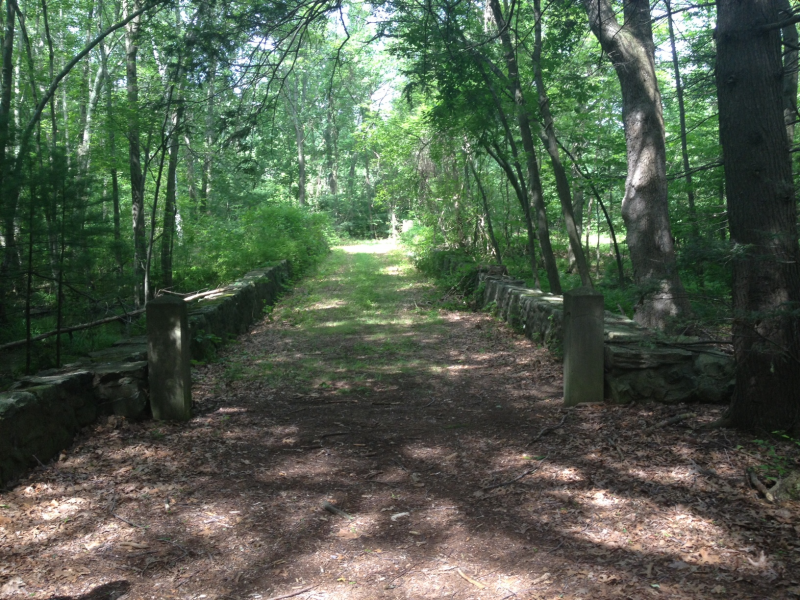
The outer loop at Macomber is about a mile around. It has gently rolling hills over a soft dirt pathway. There's a fast running stream with bridges crossing it. The trees are tall and thick. Little sunlight penetrates and you get the real forest feel, And the lake is visible for a portion of the loop. There are a couple of less used inner loops too.

This week I researched the history of the place. It's pretty interesting. It turns out this guy Macomber was a big deal way back. He owned a huge estate. What is now Macomber Woods was part of it. The place had horse racing tracks that drew thousands of spectators. Later he even had car racing. He had an enormous mansion with monumental stables, but they burned down in a tremendous fire. The rebuilt estate still stands at 450 Salem End Rd. When Macomber died the estate was turned over to an animal rights group and they ran an educational farm there. Part of it got sold off to build mega McMansions, but the rest is conservation land. That's the part I enjoy today.
What follows is what I've found on the web about Macomber Woods, Macomber Farms and the Macomber Estate.
Framingham.gov
Macomber: The town acquired part of the Macomber Estate, known as Raceland, in 1971 for conservation purposes. This 57 acre parcel encompasses meadows, wetlands and upland forest. The north border is Stearns Reservoir #1 of the Sudbury River, which is maintained by the MA Water Resources Authority.
Barton Brook, a rocky babbling stream, runs through the property creating beautiful wooded wetlands. Barton Brook splits in the middle of Macomber (an unusual phenomenon); one branch drains to an emergent marsh and the other runs merrily down to the Reservoir.

Maps
Entrance into Macomber: The entrance to the property is at the break in the stone wall on Badger Road, about 1000 feet south of Salem End Road. Ample parking is available. The trails begin beyond the gate at the end of the paved drive, and loop through white pine and hemlock woodland.
Trails: The broad trails are old carriage roads with stone and metal grate bridges where they cross Barton Brook. A short trail goes around the inner woodland without crossing the stream; a longer trail crosses the stream four times and provides lovely views of Stearns Reservoir.
Raceland: Raceland was the name of the estate owned by John R. Macomber. It is located off Salem End Road between Singletary lane and Badger Road. Macomber had a couple of horse race tracks built on the property. The Eastern Horse Club had annual race meets there, attended by thousands.
John Macomber lived in a pretty large mansion with built-in stables. Yes, he was single (never married). The mansion burnt down in 1930.
Sportsman Macomber last week collected $125,000 fire insurance on Raceland, his home and track in Framingham Centre, Mass., announced he will rebuild.
Excerpt taken from a Times article dated Monday, Aug. 25, 1930. Macomber did indeed rebuild the mansion but using more fire-resistant materials like brick and mortar. It is still standing today.
John R. Macomber was in the finance business. He was President of Harris and Forbes Co., a financial company that specialized in the marketing of municipal bonds. He later became President and then Board Chairman of the First Boston Bank (now part of Crédit Suisse), a New-York based investment bank.
He must have loved his animals because he arranged a trust that would take care of them after his death. He apparently also had an interest in automobiles because Raceland was the location for the first VMCCA (Veteran Motor Car Club of America) auto meeting in 1939.
After the death of Macomber in 1955, the property was managed by his estate manager, Adnah Neyhart. When she passed away in 1971, the MSPCA (Massachusetts Society for the Prevention of Cruelty to Animals) took over. In the 80s, it was known as the Macomber Farm, a place to learn about farm animals. The property was later sold to real estate investors. If you go there today, the residences in the "old" Macomber Farm are quite few and expensive.
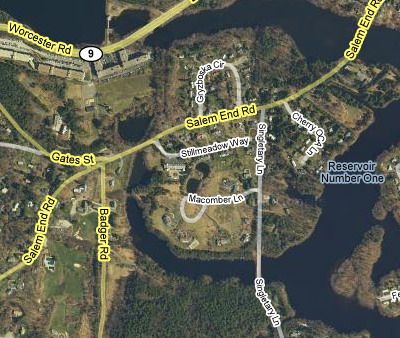 |
| A bird's eye view of the area around the old Macomber estate |
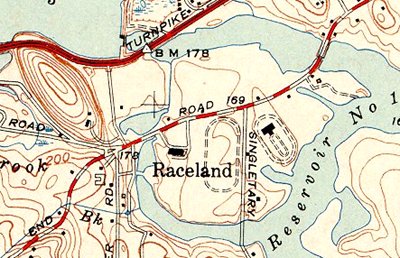 |
| The Raceland estate ca 1951. The building right above the 'ac' of Raceland is the mansion. |
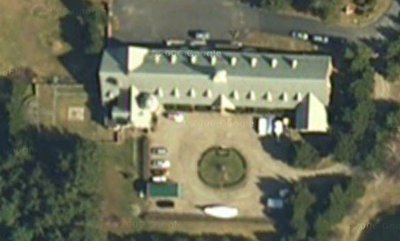 |
| The "new" mansion viewed from above |
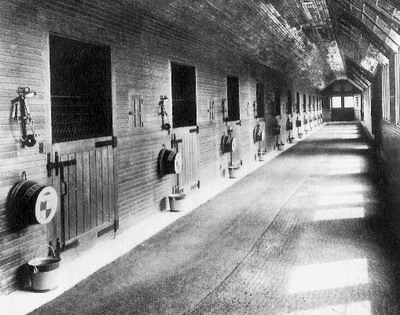 |
| The stables at Raceland. The wood used was mahogany. |
Macomber Woods is a Town of Framingham conservation property that was
established in an agreement with the developer of the homes at Singletary Lane.
Its history includes a time as a farm, a circus site and a planted woodland
garden. You can access it in daylight hours from Badger Road near the
intersection of Salem End.
established in an agreement with the developer of the homes at Singletary Lane.
Its history includes a time as a farm, a circus site and a planted woodland
garden. You can access it in daylight hours from Badger Road near the
intersection of Salem End.
Macomber Estate: located on Salem End Road, and originaly built as the private residence and stables of John R. Macomber. "Raceland" as it was called was first built in 1925, but after fire destroyed the original wood structure it was rebuilt out of brick in 1930. The estate was equipped to hold horse racing and steeplechase events which drew tens of thousands of visitiors on race days. Later, the property was operated by the MSPCA, (Massachusetts Society for the Prevention of Cruelty to Animals), as a recreational and educational facilty until it was sold again as residential property.

Bring the family for a loop hike at Macomber Estate, a gorgeous and shady wood on the Stearns Reservoir. Join us to check out the ruins of the former Raceland Estate, a popular horse racetrack in the 1920s.
The estate is now covered in shady, mature forest and babbling brooks, and provides great views of the Stearns Reservoir. Easy, flat walking makes this a great hike for young and older children, as well as beginners.
Approximately 1.5 mile loop. Registration is encouraged but not required. Cancels for hard or sustained rain.
John Macomber, the man who loved horses, was born and raised in Framingham . Around 1920 he bought a 220-acre property on Salem End Rd. and built Raceland Estate. It included a racetrack, steeplechase course, golf course, stable and kennel.
The wooden house and stables burned to the ground in 1930 and were immediately replaced with the brick stone and concrete structure you see in these photographs.
After Mr. Macomber’s death Raceland became the home of Mr. Macomber’s estate manager. Upon her death the property went to the MSPCA. They eventually sold it to developers for upscale housing lots. The handsome house & stable can still be seen through the gates of the estate.
 |
| Raceland South View |
 |
| Raceland Track |
By Emilie Tavel Livezey, The Christian Science Monitor, September 30, 1981
FRAMINGHAM, MASS. — Three curious Canada geese swoop low over the Macomber Farm and Education Center and splash to a noisy landing in the pond -- honk-honking as if to ask: "What's going on here now?"
These geese have reason to be perplexed. For generations the birds have fed on corn spread out for them here at what was once Raceland, the 46-acre estate of late Boston financier George R. Macomber. But the site was recently converted into what may be the only facility of its kind, to explore an issue rarely presented to the public: humane treatment for farm animals.
A "goose's eye" view reveals that in place of Mr. Macomber's private steeplechase and racetrack is a brand new farm, so manicured and perfect in every detail that it looks like a child's play set of handsome barns, freshly erected fences, grazing horses, mooing cattle, and crowing roosters. In every barn and winding path, school children squeal with delight at the animals they are seeing and petting -- often for the first time.
Macomber Farm is the dream of David S. Claflin, president of the Massachusetts Society for the Prevention of Cruelty to Animals (MSPCA). The land was bequeathed by Mr. Macomber -- a 38-year trustee of the non-profit, non-tax supported society. But it has taken the MSPCA five years and $7 million in private contributions to put together this unique learning center, designed to show how farm animals can be raised efficiently in an atmosphere of warmth, serenity, and loving care.
Why farmm animals? Because the MSPCA believes that today -- unlike earlier eras when food animals were grown on private farms -- this is the class of animal which is suffering the most from human abuse. The principal culprit: "factory farming."
This relatively new method of mass-producing food and fiber products from animals treats sentient creatures as if they were unfeeling bio-machines. Lifelong confinement completely restricts their normal movements, social interaction, and natural way of life.
Nancy Ann Payton, the MSPCA's humane issues analyst, says "If we were keeping dogs and cats in the same condition that we are keeping calves, swine, chickens and all these food animals, the public would be appalled, the outcry would be tremendous. We would have laws to protect them as we have laws to protect pets and zoo animals."
But, she says, few consumers have any idea of how animals that eventually wind up on the dinner table are treated while alive.
For example, Miss Payton reports that to satisfy the gourmet trade's demand for "white" (extremely tender) veal, in most factory farms calves are confined in stalls measuring 1 foot 10 inches wide by 4 feet 6 inches long, to prevent them from exercising and developing muscles. Similarly, 90 percent of all chickens are raised in layered cages so crowded that three or four must share a space no larger than a folded daily newspaper. Kept indoors, they never see the light of the sun.
It is against this background of mistreatment that Macomber Farm was established. According to Macomber's director, Robert A. Johnson, the farm's impact can be compared to "hitting the public over the head with a velvet hammer , to attract its attention and to kindle a spark of interest in and appreciation of farm animals -- and concern for their welfare."
At Macomber, every animal is clean and in perfect condition -- unafraid, contented, playful, showing forth the kind consideration it is receiving. Each candidate has been carefully "interviewed" to make sure it is friendly enough to enter public life at the farm. And each of the six animal barns has been designed to provide maximum comfort for the different species.
Macomber's large staff of well-trained young tour guides has already dubbed one barn the "Horse Hilton." Amenities include: box stalls large enough to move around and lie down in; a special shower stall for hosing down; plenty of good ventilation, plus a fire alarm system. And windows so horses can look out at the landscape. Meanwhile, goats can cavort on their own manmade hill. And dairy cows take delight in the latest equipment in their gleaming milking parlor.
Pigs -- often mistakenly thought to be naturally dirty -- are understood at Macomber to be smart and clean. When they roll in mud it is only to cool their bristly hides, because they have no sweat glands. Here a sprinkler system eliminates that need by protecting them from the heat. there are even toys to play with. When piglets want water, they push a valve with their tiny snouts to release water into their drinking trough.
The animals are the stars of this barnyard -- but every performer needs an audience. Since Macomber opened early in May, several thousand school children have arrived by the busload helping to fill this role. Every exhibit in each of the eight barns invites visitors to play games in order to learn facts about farm creatures.
At one exhibit, you can pretend to be a horse. Feel for yourself what it's like to stride with a horse's gait, or strain to pull a miniature milk wagon along a track. Then put on a fiberoptic sight mask and learn that a horse sees in almost a complete circle, but nothing at all directly in front of him.
Is your sense of smell as acute as that of a pi? Try sniffing your way out of a scent maze -- hogs are masters at it.
In every animal barn, computer games -- played by pushing keys -- flash slow-motion drawings of animals onto a screen, ask questions, and give answers.
While having fun, children begin to get the idea. They crowd around this reporter's tape recorder: "I learned that animals need shelter, that they like being with their own species, and that they help people survive, like cows give milk," says one third-grader.
Chimes in another: "I learned that animals used to be wild a long time ago and now they aren't wild, and so we have to take care of them."
That is precisely the message Macomber Farm is intended to convey. "What we have got to get across to the public," says Miss Payton, "is that if you are going to eat and use animal products, you have to take responsibility to insure that they are raised, maintained, and killed in the most humane conditions possible."
As the trend towards factory farming in America intensifies, concern about the conditions it creates is also rising among humane groups. MSPCA and its sister organization, the American Humane Education Society (whose headquarters are also at the farm) are in the vanguard.
Miss Payton says the public's current attitide is that it is all right to treat farm animals differently from pets and zoo residents, because they are sources of food. "But that makes them second-or third-class animals. We feel that a calf is just as deserving as a dog in a kennel."
As a first step, the public must be informed and sensitized to what the humane community regards as the six basic rights of farm animals -- freedom to turn around, get up, lie down, stretch their limbs, groom themselves, and enjoy the companionship of their own kind. Until awareness grows, Miss Payton says lobbyists cannot bring effective pressure upon lawmakers to introduce humane legislation. One Massachusetts legislator expressed a common viewpoint by exclaiming, "Don't even talk to me about chickens?"
At present, MSPCA reports "there are no federal laws that regulate the treatment of farm animals during the rearing process." Most states, including Massachusetts, have anticruelty statutes. Yet in this state, as in most others, such laws do not specifically protect farm animals.
With the help of Macomber Farm and other projects, MSPCA hopes eventually to win clear legal rights for livestock. AS Miss Payton writes in Animal, the MSPCA magazine:
"Humane societies have avoided the intensive-farming issue, citing a myriad of rationalizations for not actively opposing this blatant cruelty. It is about time we changed our perspective. Instead of thinking of reasons why not to act, let us concentrate on the one reason why we must act -- the animals are suffering!"


Excepts from "Framingham Legends and Lore" by James Parr and Kevin Swop
By 1922, the Millwood Hunt Club’s horse show had moved to Reginald Bird’s Waveney Farm to accommodate the large crowds. Over 300 horses competed in over fifty classes over two days, attracting horse lovers from all over New England. By 1929, over twenty hunt teams gathered to compete, wearing Millwood Hunt colors known far and wide. Also in the twenties, steeplechase racing and Eastern Horse Club events attracting up to 20,000 people were held at Raceland, John Macomber’s estate on Salem End Road. E. F. Bowditch ancestors active in Framingham include former Selectman John P. Bowditch, Mrs. Reginald Bird and Mrs. Robert Perkins and their families.
Raceland Photos
 |
| Raceland Races |
 |
| Race Spectators at Raceland |
 |
| Raceland Aerial View |
The Town of Framingham acquired part of the Macomber Estate, known as “Raceland”, in 1971 for conservation purposes. This 57-acre parcel encompasses meadows, wetlands and upland forest. The north border is Stearnes Reservoir #1 which is maintained by the Mass Water Resources Authority (MWRA). Barton Brook runs through the property creating wooded wetlands. One of its unusual features is that it splits in the middle of Macomber with one branch draining to an emergent marsh and the other running merrily down to the Reservoir. A trail map of the area can be obtained here .
The entrance to the property is at the break in the stone wall on Badger Road, about 1000 feet south of Salem End Road. Ample parking is available in the grass to the right of the entrance. The trails begin near the old dog kennel (recently demolished) beyond the gate and loop through the white pine and hemlock woodland.
The broad trails are old carriage roads with stone and metal grate bridges where they cross Barton Brook. A short trail goes around the inner woodland without crossing the stream; a longer trail crosses the stream four times and provides lovely views of Stearnes Reservoir. This a a great area to do some mountain biking.
Due to the fact that the final was muggled in Aug. 2011, it has been cleaned and replaced into a different area.
[9/3/11] The recent Hurricane Irene has caused a number of trees to come down onto trails. Walkers and bikers will need to walk around these until the Framingham Conservation Commission can get there and clear the paths but this is only in a few places.
By Susan Daar, Cape Cod Times, June 5, 1983
For those generations growing up and growing older out of earshot of a rooster's good morning, there is Macomber Farm, a blend of working farm, petting zoo and state-of-the-art educational facility. The two-year-old complex, set on 46 acres not far from the Massachusetts Turnpike in Framingham (22 miles west of Boston) was designed by the New York firm of Edwin Schlossberg for the Massachusetts Society for the Prevention of Cruelty to Animals.
Not surprisingly, then, what distinguishes Macomber (pronounced MAY-kumber) from other farm-cum-museum-cum-schools is that visitors may appreciate not only farming from the farmer's point of view, but also being farmed from the animal's point of view. At Macomber, it is not enough to cultivate the acquaintance of a thoroughbred horse, a Holstein cow or a 2 1/2-year-old, 450-pound Yorkshire sow. One may see the world as the animal sees it; the farm supplies the mechanical and electronic means to do so.
Just outside the swine barn, for instance, are sets of binoculars, some at adult height, some at child height. Look through them and see the way a pig does. The vision is remarkably like our own: binocular, in full color and in three dimensions.
Across the way is a ramp labeled, ''Can You Walk Like a Pig?'' To try ''Pig Walking,'' begin at ''Start'' and carefully place hands and feet in the bronzed pig footprints in the sequence indicated - RF for right front foot, LH for left hind, and so forth.
Nearby, a visitor is invited into a grove of colored pipes to try out ''Pig Smelling.'' In each pipe, set upright in the ground, are three sets of perforations, at levels corresponding to various human heights. The trick is to keep sniffing at the pipes until you identify five emitting the same scent.
Having thus seen, walked and smelled in the way that a pig does, a visitor can continue to learn about pigs. Just inside the swine barn is a corridor labeled ''Pig Tales,'' lined with poster-size color slides of pig life and a series of large video screens. Push the proper button and each screen lights up with a multiple-choice question about the slide above it. The slide above the first screen shows a row of piglets nursing from a sow. ''The boss of this litter of piglets is ...,'' the screen prompts, and then offers three possible answers: ''1. The piglet who was born first; 2. The piglet nursing closest to the sow's head; 3. None of them. Piglets don't care who's boss.''
If a visitor answers by pushing buttons 1 or 3, the screen flashes: ''No -Try Again.'' If he or she pushes 2, the machine gives an explanation: ''Yes,'' it says. ''Piglets struggle to be boss so they can get the most milk, so the piglet nursing there is boss while the litter stays together.''
At the barn's exit are two more special displays. A computer terminal will answer pre-programmed basic questions about pigs on various levels - primary reader, adult or ''in-depth'' - depending upon the inquirer's choice.
In the main part of the barn are the subjects of all this begadgeted interest. Well within petting distance are the 450-pound sow named Big Mama, snoozing stonelike, and nearby a Yorkshire boar named Hot Shot or a Duroc sow named Cherry.
The barn, like all those on the farm, is a nice place to live in, not to mention visit: It has high ceilings, skylights and exhaust fans; its concrete floors are immaculate and its pig bedding retains the heady, sweet scent of fresh hay.
Except for the 200-year-old New England barn, almost every exhibit has binoculars and a ramp to encourage seeing and walking like each animal, the computer terminal question-and-answer machine, a population of representative breeds, and many other games that up to 12 at a time can play.
The fowl barn, for example, houses chickens, turkeys and a computer game that challenges visitors to interpret animal body language, thus drawing their own conclusions about the meaning of ''pecking order.'' In one sequence, cartoon chickens named Red and Chick stage an episodic fight; between rounds, the onlooker is asked what the action means, particularly in its effect on status within the flock.
The horse barn is home to a similar game, based upon the relationship between horse and rider. And just outside the barn entrance is the ''I'm Working Like a Horse'' game, in which visitors, usually in groups of three or four, try to move miniature vehicles - a log skid, a milk wagon and a Conestoga wagon - anchored to simulate the weight of their full-sized counterparts. Such, one discovers, is the meaning of horsepower.
The sheep and cattle barn is home to two of the farm's current stars, Marie and Spike, a shaggy-coated, long-horned Scottish Highland cow and her calf. Just behind the barn is a cattle-handling facility with fenced pens and narrow, walled chutes, leading to a metal cage for veterinary care.
There are also less spectacular exhibits, such as a mechanical egg weigher. Everywhere, too, are farm guides, helpful presences in royal blue shirts and white trousers and tennis shoes.
Then there are the demonstrations - five or more a day, the number waxing with the season. At one session in the milking parlor, an Ayrshire and a Jersey are on stage. Held in place on the elevated platform by galvanized steel gates, they munch unconcernedly from stainless steel bins while the stainless steel fingers of the milking machine coax just the right amount out of their udders and into transparent containers marked in one-pound gradations. When the little yellow light of the electronic milking monitor goes out, the fingers drop away; the milking is over.
Breezy commentary (''That's it -honest-to-goodness moo juice'') on milking parlor proceedings is supplied by the resident farm manager Roger Lauze, a dark-bearded man in a straw hat. He presides, too, at the horsepower demonstration, driving a democrat wagon (''nothing to do with politics'') and discoursing on everything from his dapple gray's harness to the proper costume for riding sidesaddle.
Because there's easily a day's worth to do there, the farm provides for the basic needs of human beings as well. For elbow room, there are the farm's wide walkways and large open spaces, indoors and out; it would take many times the 500-or-so guests of a recent Sunday visit to make the place seem crowded.
For the hungry, there are picnic tables among the pines near the parking lot and more within the farm grounds proper. The food barn has lunch items at reasonable prices - an edible hot dog for 75 cents, a decent hamburger for 95 cents, a $1.25 green salad, and the like. There are water fountains at most of the buildings.
The only possible disappointment in store is for those who like to buy souvenirs; they may find the stock in the smallish gift shop somewhat limited. This year's outstanding offering is a commendable collection of animal-shaped appliqued throw pillows, tote bags and quilted potholders.
Macomber Farm is open daily, April 1 to Oct. 30, from 9:30 A.M. to 5 P.M. weekdays, 10 A.M. to 6 P.M. weekends and holidays. The farm is at 450 Salem End Road, Framingham, Mass. (617-879-5345). It is easily reached by taking the Framingham exit of Interstate 90 (the Massachusetts Turnpkike). A sign on State Route 9 indicates a turn into Temple Street, and a Temple Street sign shows the turn into Salem End Road.
Individual admission costs $4 for people 60 and over, $5 for other adults, $2.50 for children 3 through 12, and nothing for those under 3. Special group admission rates are available.
For those sums, what the intellectually curious visitor gets is at least a glimmer of what the naturalist Loren Eiseley meant when he said: ''One does not meet oneself until one catches the reflection through an eye other than human.''

Macomber Woods in Framingham is a 57-acre oasis encompassing meadows and upland forest as well as Barton Brook, a rocky, babbling stream that creates beautiful wooded wetlands. Untouched for decades, the site has been reclaimed by nature, yet stonework, cattle guards, and century-old wisteria vines and rhododendrons evoke a sense of the human influence.


